








CNC Chip Fan Guide: Why Solid Billet Aluminum Is Replacing Folding Blades
By Michael Gimbel · Gimbel Automation
We didn't set out to make a chip fan. We build CNC automation systems—spindle grippers, vises, pallet changers. The chip fan happened because we kept watching the same failure mode kill our customers' uptime.
Here's the scene. A shop invests in automation—maybe a robot, maybe a pallet changer, maybe one of our spindle gripper systems. The vise opens and closes on M-code, everything is humming along. Then three months in, we get the call: "The machine alarmed out overnight. Found a broken fan blade sitting in the chip tray and parts just kept loading onto a dirty fixture." Scrapped parts. Sometimes a crashed spindle. All because a $3 nylon blade decided it was done.
That happened enough times that we got tired of telling people "yeah, just order the rebuild kit." So we made something that doesn't need one.
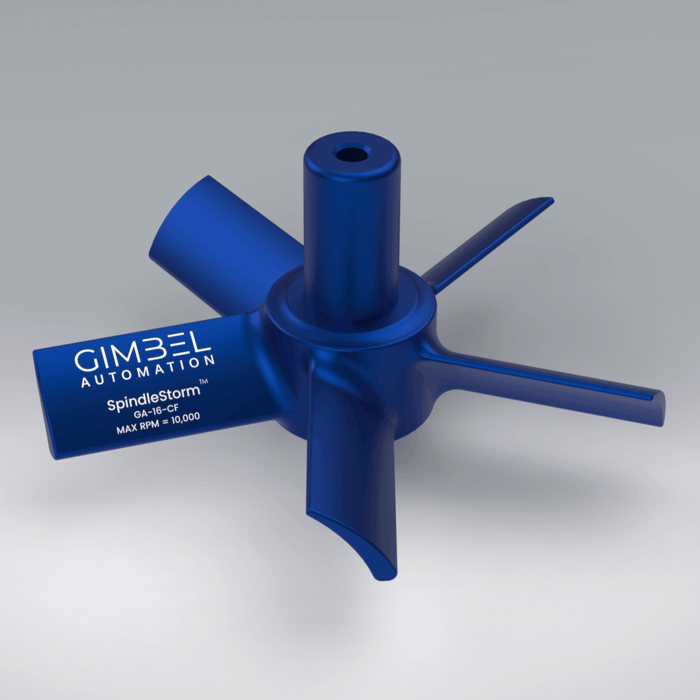
The SpindleStorm™ is a CNC chip fan machined from a single piece of billet aluminum. No folding blades, no hinges, no plastic. It goes in one ATC pocket and it's not going to break on you.
What Is a CNC Chip Fan?
A CNC chip fan is a chip removal tool that mounts in your spindle via a standard tool holder and spins at high RPM to blow metal swarf, chips, and coolant off the fixture and work zone between machining cycles. Think of it as a programmable air blast that lives in your tool magazine—one of the most overlooked milling accessories on a VMC.
CNC chip fans (also called CNC chip blowers or spindle fans) are different from other chip management tools. Unlike a chip conveyor—which evacuates bulk material from the machine bed—a chip fan targets the fixture and part seating surfaces. It's the difference between sweeping the floor and wiping the table before you set down a plate. You need both, but the chip fan is what prevents bad part seating and the crashes that follow.
For manual part loading, a chip fan is a convenience. For automated cells running unattended, it's mandatory—and the quality of the fan determines whether your lights-out run finishes or alarms out at 2 AM. That's what makes it an essential CNC machine accessory, not a nice-to-have.
What Is Swarf and Why Does It Matter?
If you're newer to machining, you'll hear the word "swarf" on every shop floor. The swarf meaning is straightforward: it's the metal chips, shavings, curls, and debris produced during CNC milling, turning, and drilling. Everything your cutter removes from the workpiece that isn't the finished part is swarf.
Metal swarf comes in different forms depending on the material and cutting parameters—long stringy ribbons from aluminum, small broken chips from cast iron, tightly curled spirals from steel. Regardless of form, swarf that isn't cleared from the work zone causes problems: it gets trapped between the part and the fixture, causes bad seating, damages surface finish, and can crash tools into material that isn't where the program expects it to be.
In a manually-loaded machine, the operator clears swarf between parts with an air gun or coolant hose. In an automated cell, there's nobody there to do that. That's where a CNC chip fan earns its place as essential CNC machine maintenance—it's the automated equivalent of the operator with the air gun, programmed right into your machining cycle.
Why Folding Chip Fans Keep Failing
The folding chip fan concept is clever. Blades fold up so it fits in a standard tool pocket, then they deploy under centrifugal force at speed. The engineering is neat. The problem is that "neat" doesn't hold up to 6,000 RPM in a flood of CNC coolant for 18 months straight.
Blade Fatigue
Nylon and fiberglass-reinforced blades flex every single cycle. They're under constant centrifugal load, soaking in coolant that slowly degrades the material. Eventually one snaps. Now the fan is unbalanced, and if you're running lights-out, nobody's there to catch it.
Rebuild Kit Treadmill
Replacement blade kits run $50–$100+. You'll go through several per year in a high-utilization shop. Over the life of the machine, you can easily spend more on rebuild kits than the fan originally cost. It's a razor-and-blades business model whether they intended it or not.
Downtime Cascades
When a blade breaks mid-cycle in an automated cell, it's not just the fan that stops. The machine alarms out, the loader idles, and the whole cell sits until someone walks over, diagnoses the problem, and orders parts. In a lights-out shop, that alarm might not get noticed until morning—an entire shift of lost production from one broken blade.
The RPM Ramp Problem
Some manufacturers actually tell you not to go straight to full RPM—you need to ramp up slowly or risk "catastrophic blade failure." Their words, not ours. Imagine programming a slow ramp-up into every automated cycle just so your CNC machine cleaning tool doesn't self-destruct.
None of this matters much if you're manually loading parts and can just swap out a broken fan during your next coffee break. But if you're running lights-out manufacturing, or you've got automated loading on the machine, or you're using a pallet changer—a broken fan blade at 2 AM means the whole cell sits idle until first shift walks in.
CNC Chip Fan vs. Chip Conveyor vs. Chip Vacuum
If you're researching chip management for your CNC machine, you'll run into three main categories of CNC machine accessories for handling swarf. Understanding where each one fits will save you from buying the wrong solution.
CNC Chip Conveyors
A chip conveyor is a belt or auger system that continuously moves bulk swarf out of the machine bed and into a collection bin. It handles the volume problem—keeping the machine bed from filling up with material over a long run. Every serious production machine should have one. But a CNC chip conveyor doesn't clean your fixture. It doesn't clear the vise jaws before the next part loads. That's not what it's designed for.
CNC Chip Vacuums
A CNC chip vacuum is typically used for post-machining cleanup or for clearing deep pockets and tap holes where chips get packed. Some are shop-floor units, others integrate with the machine. They're good for targeted extraction but they don't run between automated cycles the way a chip fan does.
CNC Chip Fans
A chip fan is a spindle-mounted chip removal tool that clears the fixture, work zone, and part seating surfaces between machining cycles. It lives in your tool magazine like any other tool, gets called up by M-code, and does a cleaning pass in 10–15 seconds. When paired with through-spindle coolant, it washes and blows dry in a single tool call.
The bottom line: chip conveyors handle bulk swarf removal, chip vacuums handle targeted extraction, and chip fans handle fixture clearing between parts. In an automated cell, you need a conveyor AND a chip fan. They're complementary, not substitutes. Note: a chip fan is also not a CNC dust collection system—if you're dry-machining graphite or composites and need airborne particle extraction, that's a different problem entirely. Chip fans are designed for clearing metal swarf from surfaces during wet or dry metal machining.
What We Did Differently
The SpindleStorm™ is not a folding fan with better materials. It's a completely different approach to CNC chip removal. We start with a solid block of 6061-T6 aluminum and machine the whole thing—hub, blades, taper adapter—in one setup. There are literally no moving parts.
Nothing to Break
No hinges. No pins. No plastic. If the blades are part of the same chunk of aluminum as the body, they can't snap off. You will never buy a rebuild kit for this fan because there is nothing to rebuild. We've had prototype units running in beta shops since late 2025 and haven't had a single failure.
Single Standard Tool Pocket
Like other chip fans, the SpindleStorm™ fits a single standard tool pocket. No special setup, no large tool definition required. Drop it in your carousel or side-mount changer like any other milling accessory.
Balanced from the Factory
Because it's machined from one piece, the concentricity is inherent to the part. There's no assembly step where things can go slightly off-center. This matters more than people think—an unbalanced fan spinning at 6,000+ RPM puts real stress on your spindle bearings. Over thousands of cycles, that adds up.
Through-Hole for Coolant Clearing
The SpindleStorm™ has a through-hole machined directly through the center of the fan body. If your machine has through-spindle coolant (TSC), coolant flows straight through the fan and onto the fixture while the blades spin—similar in concept to a CNC coolant nozzle, but combined with the air blast from spinning blades. You get high-pressure wash and air blast simultaneously—one tool call, two functions. The through-hole also means coolant isn't fighting the fan body to reach the work zone. It goes right where you need it.
Actual Airflow Engineering
This isn't just a disc with slots cut in it. We iterated on the blade pitch and profile to maximize air volume at typical spindle speeds (4,000–8,000 RPM range). We're not going to claim it's "the most powerful fan on earth" because airflow depends on RPM, enclosure size, and a dozen other factors. But it moves serious air, and it handles the heavy wet chips and CNC coolant puddles that lighter fans struggle with.
"We were going through about four sets of replacement blades a year on our Haas VF-4s. The SpindleStorm™ just kind of solved it. Put it in, forgot about it. Haven't thought about chip fans since."
— Beta tester, job shop in Southern California (3x VF-4, running two shifts with automated loading)
SpindleStorm™ vs. Lang, Kennametal, Midaco, Haas, and Redline Chip Fans
If you're comparing CNC chip fans, you're likely looking at the same set of names: Lang Technik, Kennametal, Midaco, Redline Tools, and Haas Tooling. Here's an honest breakdown.
Folding Blade Fans (Midaco, Redline, Kennametal, Haas)
These all share essentially the same design—a 4140 steel shank with fiberglass-reinforced nylon blades that deploy under centrifugal force. They work well when the blades are fresh. The issue is longevity: expect to buy replacement blade kits ($50–$100+) every few months under heavy use. Midaco, Redline, Kennametal chip fan, and Haas blade kits are cross-compatible, which tells you how similar these products are under the hood.
If you're shopping for a Haas chip fan specifically, Haas Tooling now sells their own branded version with through-coolant capability and a VPS template built into the NGC control. It works. You'll just be buying blade kits for it.
Solid Fans (Lang Technik, Big Kaiser, SpindleStorm™)
The Lang chip fan and Big Kaiser fan are also solid (non-folding) designs. The SpindleStorm™ falls into this category. The advantages of solid construction are shared: no blade breakage, no rebuild kits, inherent balance. Where they differ:
| Feature | SpindleStorm™ | Folding Fans (Midaco, Redline, Kennametal, Haas) | Other Solid Fans (Lang, Big Kaiser) |
|---|---|---|---|
| Construction | Solid Billet 6061-T6 Aluminum | Nylon/Fiberglass Folding Blades | Solid Aluminum |
| Blade Breakage Risk | None | High (fatigue/snapping) | None |
| Rebuild Kits Needed? | Never | Yes ($50–$100+ each) | No |
| ATC Pockets Required | 1 Standard Pocket | 1 Standard Pocket | 1 Pocket (may need large tool on some machines) |
| Through-Coolant | Yes | Yes (most models) | Varies by model |
| Lifetime Maintenance Cost | $0 | $200–$500+ in rebuild kits | $0 |
| Price | $129 pre-order / $399 MSRP | $150–$400+ | $300–$400+ (quote/dealer only) |
| Buy Online? | Yes | Varies | No (dealer/quote required) |
The honest summary: compared to other solid fans, specs are similar. The main differences are price (we're significantly cheaper) and the fact that you can just buy it online without calling a dealer. Compared to folding fans, the advantage is that you'll never replace a blade again—but you do give up the folding mechanism. More on that tradeoff below.
A Few Things to Know Before You Buy
We'd rather you know the tradeoffs upfront than find out after the box arrives.
It's heavier than a plastic fan. Solid aluminum weighs more than nylon blades. The SpindleStorm™ is about 1.4 lbs. If your tool changer has a low weight limit per pocket (some smaller machines do), check your specs first. Most VMCs handle it fine, but we don't want you to assume.
It doesn't fold. That's the whole point—no folding means no breakage—but it also means the profile is fixed. We engineered it to fit one standard pocket, and it does. But if your specific machine has unusually tight pocket spacing, measure first. We publish the full envelope dimensions on the product page.
It won't replace a chip conveyor. A CNC chip fan clears the fixture and work zone. It's not going to evacuate a full tray of chips from a deep pocket roughing cycle. If you're making mountains of material, you still need a conveyor. The SpindleStorm™ is for clearing the table between part loads—the two are complementary CNC machine accessories.
It's not a CNC dust collection system. If you're dry-machining graphite or composites and need airborne particle extraction, that's a dust collection problem, not a chip fan problem. Chip fans are designed for wet or dry metal machining where you need to clear metal swarf from surfaces.
CNC Chip Fans and Lights-Out Manufacturing
If nobody is there to notice a broken blade and swap it, you need a fan that isn't going to break. That's the short version.
Here's the longer version. Lights-out manufacturing—running your CNC machines unattended overnight or over weekends—is where chip fans go from "nice to have" to "critical path." The same applies to any form of lights-out machining or unattended machining. Here's the failure chain we see over and over:
Automated loading puts a blank onto a fixture that still has swarf on it. The part doesn't seat flat. Now your Z-offset is wrong by a few thou. Best case, you scrap the part. Worst case, you crash the tool into the part and take out an $800 endmill—or worse, the spindle. One bad seat from chip buildup can easily cost more than the fan itself.
We designed the SpindleStorm™ specifically for this use case. Program a tool change to the fan at the end of your machining cycle, spin it up with TSC on to wash the fixture, then let it blow dry. The whole cleaning pass takes 10–15 seconds. Your next part loads onto a clean fixture every time.
If you're already using other Gimbel products—our GimGrippers™ for spindle-mounted part handling, our AutoVises™ for pneumatic workholding, or an IntraLoad™ pallet changer—the SpindleStorm™ slots right into the same workflow. But it works with any CNC mill and any automation setup. You don't need our other stuff to use it.
Chip Fan as CNC Machine Maintenance
Most machinists think of CNC machine maintenance as oil changes, way lube, and spindle bearing checks. But the single most common preventable failure in automated machining isn't mechanical—it's chips on the fixture.
A CNC chip fan should be part of your daily CNC maintenance routine the same way coolant concentration checks are. In an automated cell, it's not optional—it's the tool that keeps every other tool from crashing. The difference between a shop that runs three shifts reliably and one that scraps parts overnight is almost always the unsexy stuff: clean fixtures, good probing, and a chip fan that actually works.
CNC machine cleaning between cycles isn't glamorous. But when you calculate the cost of one crashed spindle against the cost of a chip fan running a 15-second cleaning pass between parts, the math isn't even close.
The Backstory
Real talk: we priced the SpindleStorm™ at $129 for pre-order because we want it in as many machines as possible before the full launch at $399. Part of that is marketing—we know that. If a thousand shops are running SpindleStorm™ fans by summer, that's a thousand shops in our ecosystem when they're ready for grippers, vises, or a full automation package.
But the other part is that we think $300+ for a chip fan is absurd. We're a machine shop. We make these on our own CNC mills. Our cost basis is different from companies that outsource production, and we're passing that along. Even at $399 MSRP it'll be the cheapest solid billet option on the market.
The other solid fan companies don't even let you buy online—you have to request a quote, talk to a dealer, wait for a callback. We put ours on Shopify. Add to cart, check out, done. That shouldn't be a differentiator in 2026, but apparently it is.
Who Is This For?
Automated cells: Spindle grippers, pallet changers, any setup where parts load without a human present. Clean fixtures aren't optional here—they're the difference between running all night and scrapping a whole shift's worth of parts.
Shops running lights-out manufacturing: If nobody is there to notice a broken blade and swap it, you need a fan that isn't going to break. Pretty simple.
Shops that are done buying rebuild kits: If you've spent $200+ on replacement blades for a fan that cost $180, you already know the math doesn't work.
High-utilization machines: If you're running complex jobs with most of your pockets full, you need a CNC chip fan that drops in without any fuss. Standard pocket, no special setup.
Any CNC mill with a standard tool holder: Haas, DMG MORI, Mazak, Doosan, Okuma—if it takes a CAT40 or BT40 holder (other tapers available), it'll work.
Pre-Order the SpindleStorm™
First production batch. Ships no later than May 15, 2026.
Pre-Order Now
Limited quantities at this price. Free shipping available.
We made this because the existing options were either fragile or overpriced or both. The SpindleStorm™ is solid aluminum, fits one pocket, costs less than most folding fans, and you'll never have to think about it again after you install it. That's the pitch.
If you've got questions about fit, compatibility, or how to program a chip fan into your automated cycle, hit us up at sales@gimbelautomation.com or call 855-444-3918. We actually answer.
CNC Chip Fan FAQ
What is a CNC chip fan and why do I need one?
A CNC chip fan is a chip removal tool that mounts in your spindle via a standard tool holder and spins at high RPM to blow metal swarf, chips, and coolant off the fixture and work zone between machining cycles. It's essential for automated CNC cells—spindle grippers and pallet changers need a clean fixture to seat parts correctly. Without one, chips cause bad part seating, scrapped parts, and potential spindle crashes.
What is swarf in CNC machining?
Swarf is the industry term for the metal chips, shavings, curls, and debris produced during CNC milling, turning, and drilling operations. Metal swarf that isn't cleared from the fixture causes bad part seating, surface finish problems, and tool crashes. A CNC chip fan is the standard tool for automated swarf removal between machining cycles.
How does a CNC chip fan compare to a chip conveyor?
A chip conveyor evacuates bulk swarf from the machine bed via belt or auger. A CNC chip fan clears the fixture and part seating surfaces between machining cycles. They solve different problems and are complementary CNC machine accessories—most automated cells need both. A chip fan is a tool magazine accessory; a chip conveyor is a machine-level system.
Does the SpindleStorm™ fit a standard ATC pocket?
Yes. The SpindleStorm™ fits a single standard tool pocket in any automatic tool changer. It works with CAT40, BT40, and other common taper sizes. No special setup or oversized pocket definition is required—drop it in your carousel like any other tool.
How does through-spindle coolant work with the SpindleStorm™?
The SpindleStorm™ has a physical through-hole machined through the center of the fan body. If your machine has through-spindle coolant (TSC), coolant flows straight through the fan and onto the fixture while the blades spin. This gives you high-pressure wash and air blast simultaneously in a single tool call.
Why is a solid billet chip fan better than a folding chip fan?
Folding chip fans use nylon or fiberglass-reinforced blades that fatigue and snap over time, especially under continuous use in coolant. A solid billet fan like the SpindleStorm™ is machined from a single piece of 6061-T6 aluminum—no hinges, no pins, no moving parts. There are no blades to break and no rebuild kits to buy. For lights-out manufacturing and automated cells, this eliminates a common failure point that can shut down your entire operation.
Is the SpindleStorm™ better than a Lang chip fan or Kennametal chip fan?
The SpindleStorm™, Lang chip fan, and Kennametal chip fan serve the same purpose but differ in construction and purchasing. Lang and Kennametal offer both folding and solid options. The SpindleStorm™ is solid billet aluminum only—no folding blades, no rebuild kits. The main advantages over competitors are price (significantly lower than Lang or Big Kaiser solid fans) and the ability to purchase online without going through a dealer or requesting a quote.
What CNC machines is the SpindleStorm™ compatible with?
The SpindleStorm™ works with any CNC mill that uses a standard tool holder—Haas, DMG MORI, Mazak, Doosan, Okuma, and others. It's available in CAT40 and BT40 tapers, with other taper options available. It weighs about 1.4 lbs, which is within the tool weight limit of most VMCs, but check your machine's specs if you have a smaller tool changer.
How do I program a chip fan into my automated machining cycle?
Program the chip fan like you would a face mill. Call a tool change to the fan pocket, ramp to operating RPM (4,000–8,000 RPM), and program a pass over the fixture and work zone. Turn on TSC if available for a wash-down. The full cleaning pass takes about 10–15 seconds. On Haas machines, a VPS template (Table Wash Cycle) is available in the NGC control.
More about our CNC automation products at gimbelautomation.com. Follow the build on Instagram @gimbelautomation.