







Pneumatic Grippers for CNC Automation
Pneumatic grippers use compressed air to close their jaws on a part, then open to release it, and ours do that job straight from your CNC spindle. GimGrippers are pneumatic grippers that load into your tool changer like any other tool, grab a piece of stock, and load the machine for you. There is no robot arm, no separate cell, and no six-figure integration. Standard models grip parts up to 10 lbs, high-force models up to 40 lbs, and pricing starts at $1,379, ready to run on Haas, Fanuc, Brother, Doosan, Hurco, and DMG Mori.
Most people comparing grippers are looking at robot-mounted or electric units. If you run a CNC, there is a shorter path worth knowing about. Your machine already positions to a tenth, so we seat the gripper in the spindle and let the machine handle the loading. That is what separates a Gimbel pneumatic gripper from the robot tooling that fills most of these results, and it is why a shop can automate one machine for a fraction of the cost of a robotic cell.
Every GimGripper4™ is a pneumatic spindle gripper built around the same adjustable parallel jaws. What changes between models is how the air reaches the gripper and how much the jaws can hold. Pick the one that matches how your machine is plumbed and how heavy your parts run.
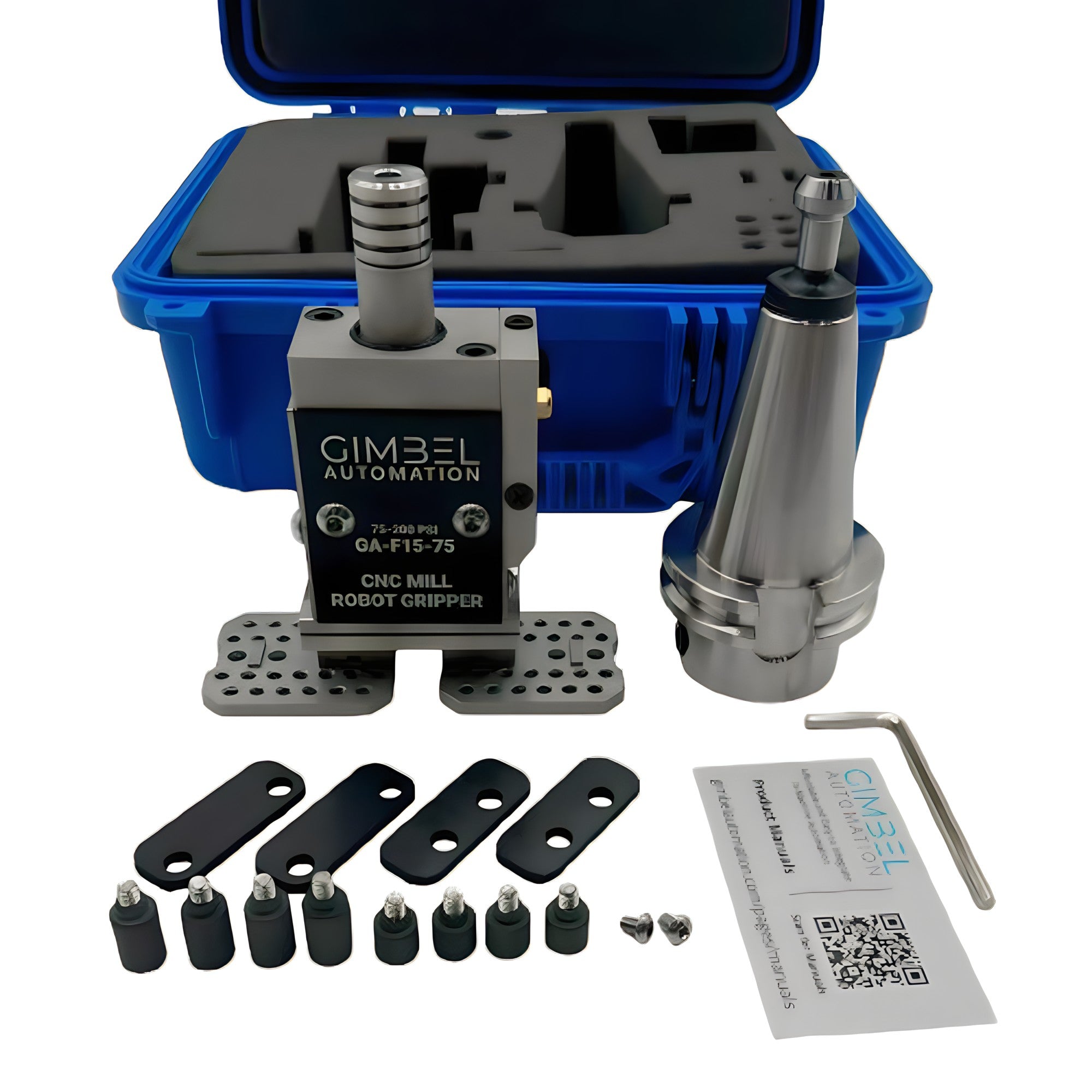
TSA GimGripper4™ (Through-Spindle Air)
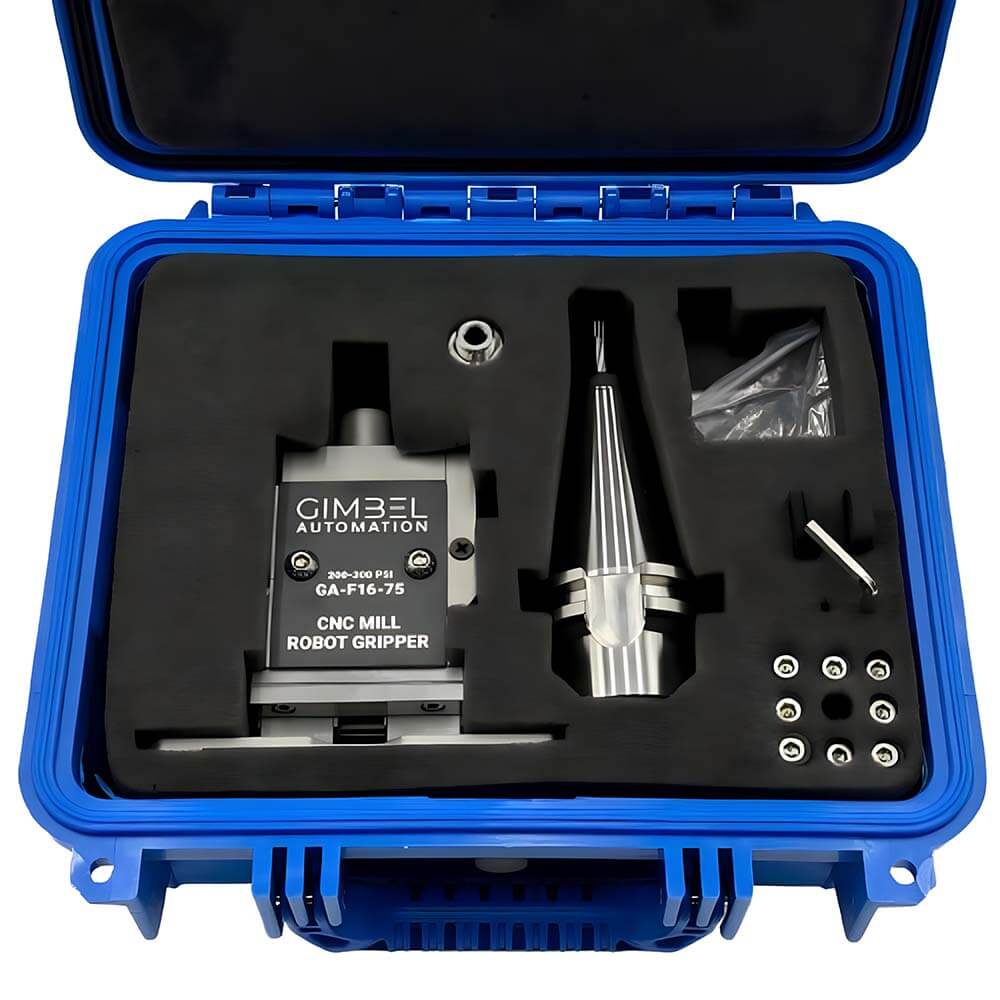
This is the flagship pneumatic gripper and the one most shops start with. If your machine has through-spindle air, the TSA connects to it directly and closes its two adjustable jaws on round or square stock with no custom fingers to machine. It holds ±0.001 inch repeatability across up to 2,000,000 actuations and grips parts up to 10 lbs.
TSC GimGripper4™ (Through-Spindle Coolant)
Same parallel jaw design, actuated by your machine's coolant line instead of air. It is the right pick when you have through-spindle coolant but not through-spindle air, and it runs on standard coolant pressure. Grips parts up to 10 lbs.

High Force GimGripper4™
Roughly four times the grip of a standard model, for heavier billets, castings, and large-diameter stock up to 40 lbs. It uses the same adjustable jaw system and comes in both air and coolant versions.

FloLink™ GimGripper4™
Not every machine has through-spindle air or coolant. FloLink solves that with a patent-pending rotary bypass that feeds air in from outside the spindle while an internal union lets the gripper turn with spindle rotation. Any machine with a standard tool changer can now run a pneumatic gripper, in standard or high-force grip.

GimVac3™ Vacuum Gripper
Some parts have no edge to clamp. GimVac turns through-spindle air into vacuum and lifts flat-faced parts by suction, up to 25 lbs, so you can tend sheet, plate, and disc work that jaws cannot hold. Run it alongside a jaw gripper for mixed part families.
Here is the lineup at a glance:
| Model | Actuation | Max Part Weight | From |
|---|---|---|---|
| TSA GimGripper4™ | Through-spindle air | 10 lbs | $1,379 |
| TSC GimGripper4™ | Through-spindle coolant | 10 lbs | $1,379 |
| High Force GimGripper4™ | Air or coolant | 40 lbs | $1,629 |
| FloLink™ GimGripper4™ | External air bypass | 10 or 40 lbs | $2,149 |
| GimVac3™ | Vacuum from through-spindle air | 25 lbs | $1,249 |
Every gripper ships as a complete, ready-to-run kit with adjustable FastFinger™ plates, takes a single tool slot, and is designed and built in the USA. Pair any of them with an AutoVise™ pneumatic vise to clamp the part once it is loaded, and you have a full self-loading cell. Shop all CNC grippers.
Why Shops Choose a Pneumatic Gripper Over a Robot or Electric Unit
A spindle gripper is a pneumatic gripper in a tool holder. Same compressed air, same parallel jaws, different mount. Where an industrial pneumatic gripper bolts to a robot flange, a GimGripper seats in a CAT40, BT40, BT30, or HSK holder and lets the CNC do the positioning.
Air drives an internal piston that pulls two opposing jaws closed along parallel tracks, so both jaws travel the same distance from center and keep the part on the grip axis. The fingers are normally open and close on demand, and the adjustable plates cover a wide range of round and square sizes without custom tooling. You call the gripper from the tool magazine with standard M-code, the same way you call a drill, and run the load-and-unload moves in ordinary G-code. Grip force tracks air pressure, service falls at every 250,000 cycles, and each GimGripper4™ is rated for over 2,000,000 actuations before rebuild. One operator can watch five or six machines running this way instead of standing at one.
How Our Pneumatic Grippers Work
A spindle gripper is a pneumatic gripper in a tool holder. Same compressed air, same parallel jaws, different mount. Where an industrial pneumatic gripper bolts to a robot flange, a GimGripper seats in a CAT40, BT40, BT30, or HSK holder and lets the CNC spindle do the positioning.
Air drives an internal piston that pulls two opposing jaws closed along parallel tracks, so both jaws travel the same distance from center and keep the part on the grip axis. The fingers are normally open and close on demand, and the adjustable plates cover a wide range of round and square sizes without custom tooling. You call the gripper from the tool magazine with standard M-code, the same way you call a drill, and run the load-and-unload moves in ordinary G-code. Grip force tracks air pressure, service falls at every 250,000 cycles, and each GimGripper4™ is rated for over 2,000,000 actuations before rebuild. One operator can watch five or six machines running this way instead of standing at one.

Types of Pneumatic and Industrial Grippers
Grippers are grouped by what powers the jaws and by how those jaws move. A quick map helps if you are weighing options.
By power source, there are three families. Pneumatic grippers run on compressed air, cycle fast, and cost the least to own, which is why they dominate machine shops. Electric grippers use a servo to set jaw position and force in software, useful for fragile or varying parts at a higher price. Hydraulic grippers use fluid pressure for the heaviest clamping loads in heavy industry.
By jaw motion, most pneumatic grippers are 2-jaw parallel grippers, where two jaws close in a straight line and hold the part square. A pneumatic parallel gripper, sometimes written parallel pneumatic gripper, is the standard for CNC tending because it centers the part cleanly and repeats. The two-finger, or 2 jaw, layout is the default across the industry, while three-jaw centric versions self-center round stock. If you want the full breakdown of jaw geometry, see our parallel grippers page. All GimGripper models are pneumatic parallel grippers, apart from the GimVac vacuum option.
FAQs
A pneumatic gripper is an air-powered device that opens and closes two or more jaws to grip, hold, and release a part. Compressed air drives a piston, and the piston moves the jaws. Shops use pneumatic grippers to load machines, feed lines, and run pick-and-place work automatically, without an operator touching each part.
Yes. A spindle-mounted pneumatic gripper loads into your CNC tool changer and uses the machine's own axes to move parts, so no robot arm or cell is needed. This is the lowest-cost way to automate a mill or lathe, because the machine you already own supplies all the motion and precision.
They are. A spindle gripper is a pneumatic gripper built to run from a CNC spindle instead of a robot flange. It uses the same compressed air and the same parallel jaws as any industrial pneumatic gripper. The only real difference is the mount and the fact that the machine, not a robot, moves it.
pneumatic parallel gripper uses air to close two jaws that move straight in and out, staying parallel through the stroke. Also called a 2 jaw gripper or a two jaw parallel pneumatic gripper, it is the most common style in manufacturing because it centers parts well and repeats across millions of cycles. Every GimGripper jaw model is one.
Almost certainly. If your machine has through-spindle air, use a TSA model. If it has through-spindle coolant, use a TSC model. If it has neither, the FloLink system adds a pneumatic gripper using an external air line. The grippers fit CAT40, BT40, BT30, and HSK tapers and have run on machines from most major brands.
For loading a CNC, pneumatic is usually the better value. It runs on the air you already have, grips hard for its size, and costs far less than an electric unit plus the robot to carry it. Electric grippers make sense for delicate assembly that needs programmable force, which is a different job than machine tending.
Gimbel pneumatic spindle grippers start at $1,379 and ship as complete, ready-to-run kits, so tooling and hardware are in the price rather than a parts list. High-force models start at $1,629 and FloLink models at $2,149. Robot-mounted industrial grippers vary widely, and most also require the robot and cell around them.