







Parallel Grippers for CNC & Industrial Automation
Parallel grippers use two synchronized jaws moving in a straight, linear motion to clamp and release workpieces during automated production. They are the most widely used gripper type across manufacturing, from robotic pick-and-place cells to CNC machine tending.
GimGripper4™ parallel grippers are pneumatic 2-jaw parallel grippers that mount directly in your CNC spindle via the tool changer. They grip raw stock, load it into the vise, unload the finished part, and repeat. No robot arm. No automation cell. The machine does the work.
Standard models handle parts up to 10 lbs. High-force parallel grippers grip up to 40 lbs. Every GimGripper4™ model is rated for over 2,000,000 actuations and ships ready to run on Haas, Fanuc, Brother, Doosan, Hurco, and DMG Mori machines. Available in through-spindle air (TSA), through-spindle coolant (TSC), and FloLink™ configurations for machines without through-spindle capability.
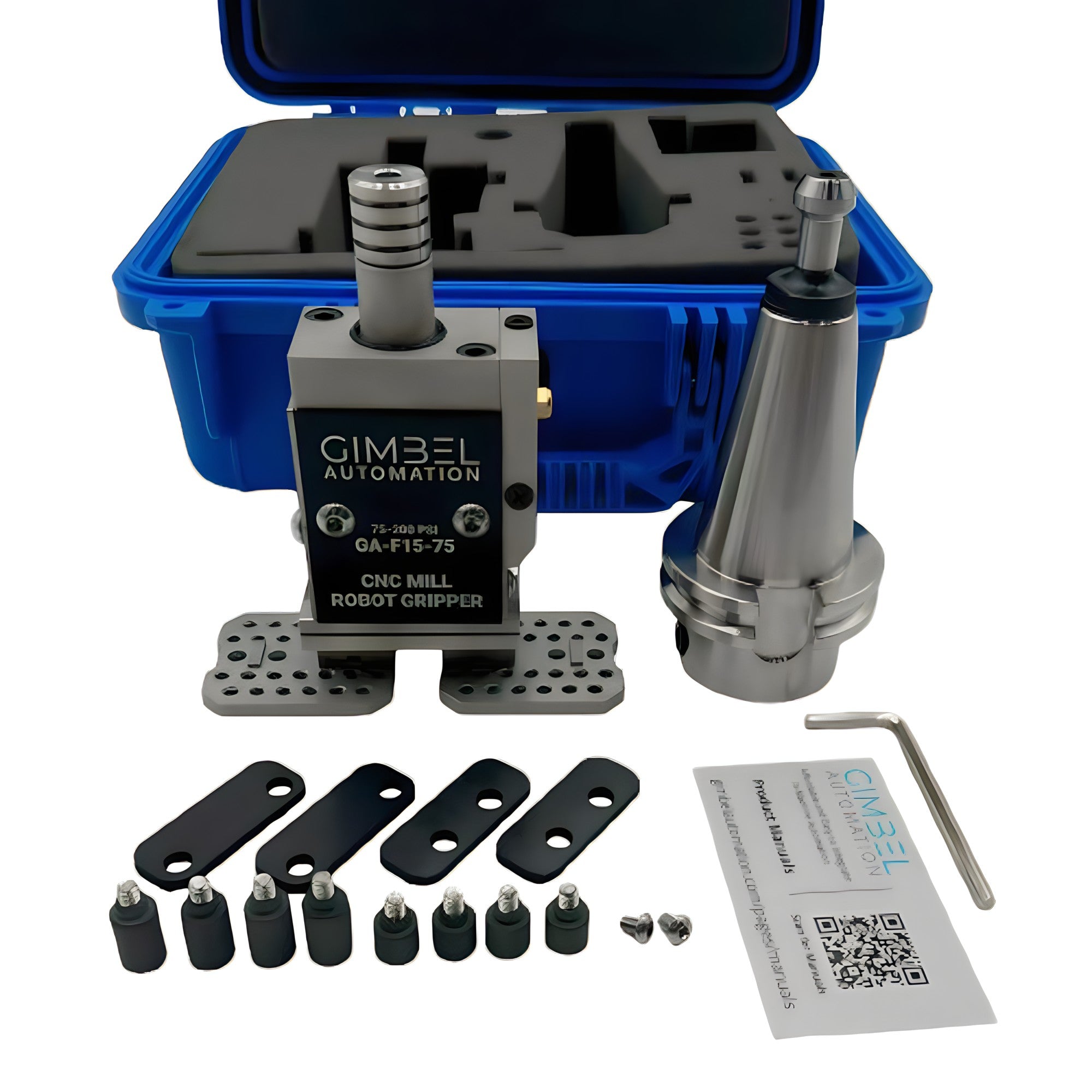
TSA GimGripper4™ Through-Spindle Air Parallel Gripper
The most popular pneumatic parallel gripper in the GimGripper4™ lineup. The TSA model connects to your machine's existing through-spindle air supply and uses two adjustable parallel jaws to grip round or rectangular stock without custom-machined fingers.
Features:
- Pneumatic 2-jaw parallel gripper with adjustable fingers
- Handles parts up to 10 lbs
- Actuated via through-spindle air (TSA)
- 2,000,000+ cycle life, service every 250,000 actuations
TSC GimGripper4™ Through-Spindle Coolant Parallel Gripper
Identical parallel jaw mechanism to the TSA, but actuated through your machine's coolant system instead of air. Built for CNC machines where through-spindle coolant is available but through-spindle air is not.
FEATURES
- Pneumatic 2-jaw parallel gripper, coolant-actuated
- Handles parts up to 10 lbs
- Converts coolant pressure to pneumatic jaw actuation
- Same 2,000,000+ cycle rating as all GimGripper4™ models
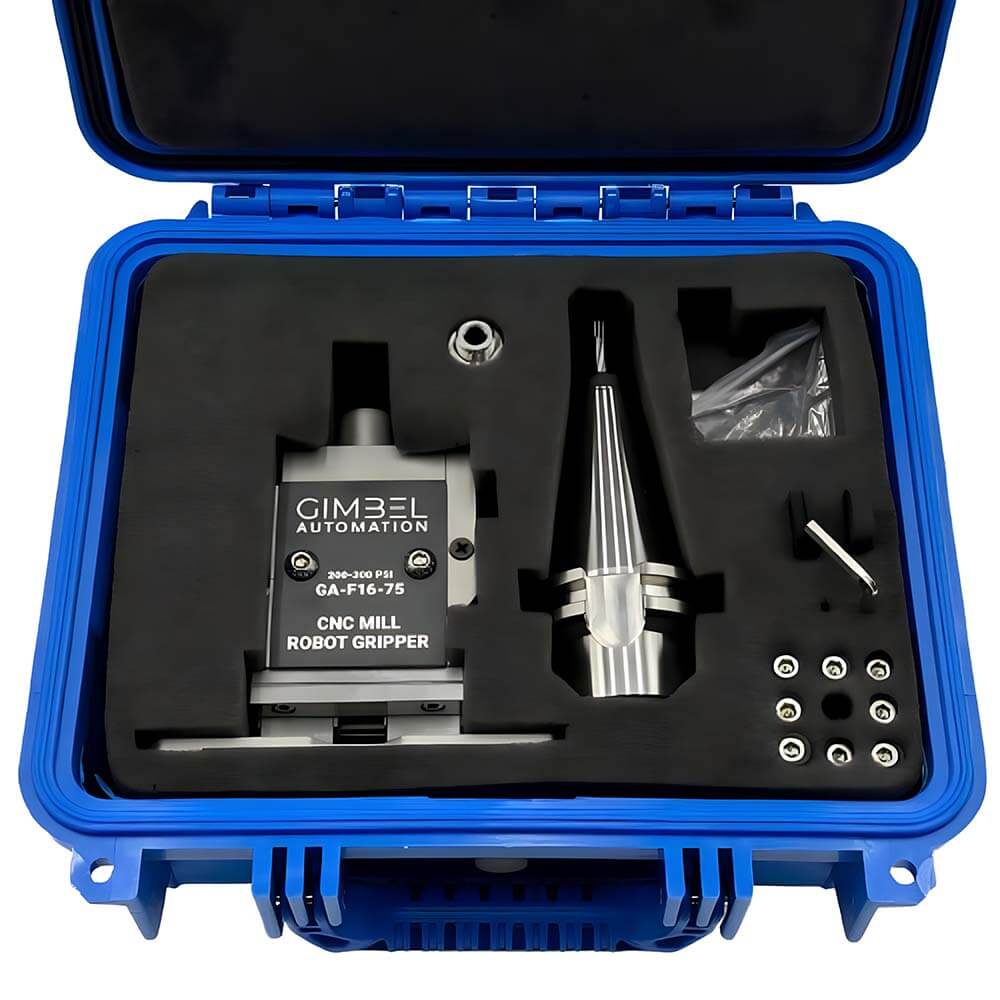
High Force GimGripper4™ Heavy-Duty Pneumatic Parallel Gripper
When standard grip force is not enough. The high-force pneumatic parallel gripper handles parts up to 40 lbs with the same adjustable parallel jaw system as the standard GimGripper4™. Available in both TSA and TSC configurations.
FEATURES
- High-force pneumatic 2-jaw parallel gripper
- Handles parts up to 40 lbs
- Available as TSA (air) or TSC (coolant)
- Ideal for oversized billets, heavy castings, and large-diameter stock

FloLink™ GimGripper4™ Parallel Gripper for Any CNC Machine
Not every CNC machine has through-spindle air or coolant. The FloLink™ system uses a patent-pending rotary air bypass to deliver pneumatic actuation externally, so any machine with a standard tool changer can run a parallel gripper. Available in standard and high-force versions.
- Pneumatic 2-jaw parallel gripper with external air supply
- Standard: up to 10 lbs / High Force: up to 40 lbs
- Works on machines without TSA or TSC capability
- Patent-pending FloLink™ rotary bypass system

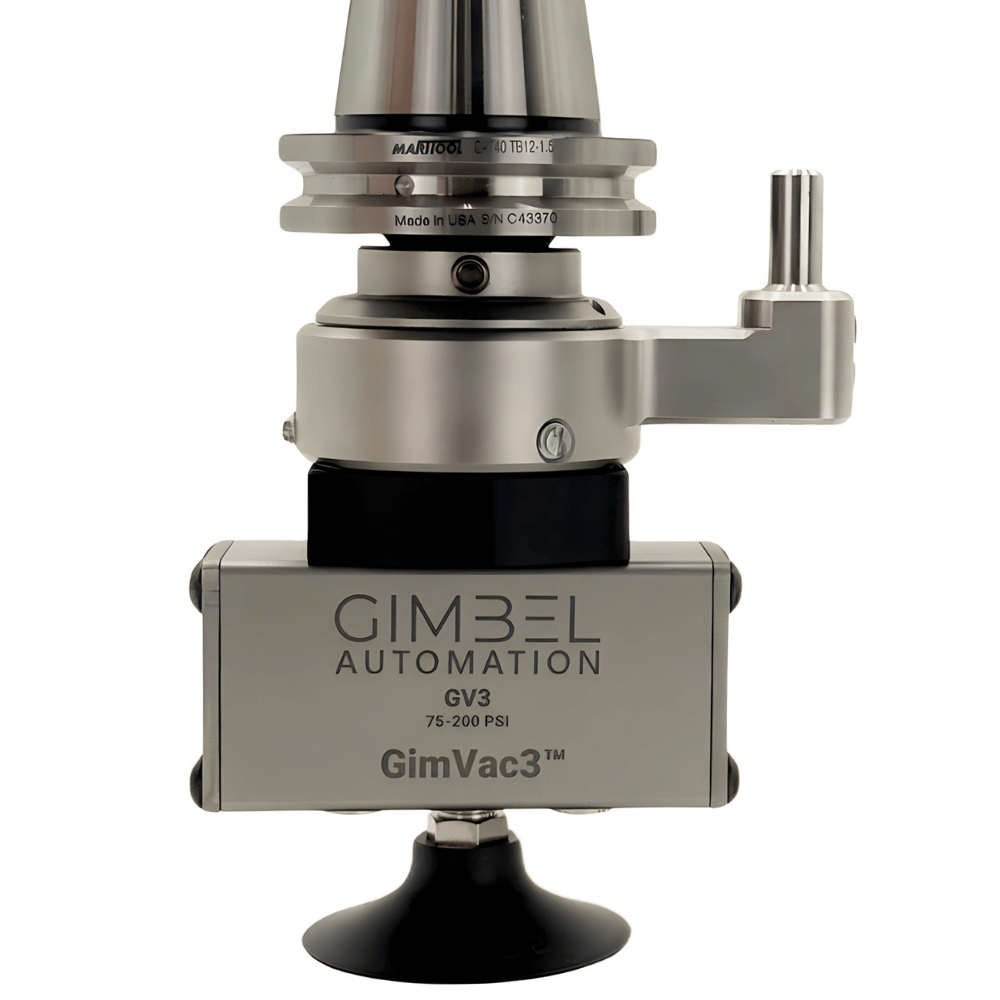
GimVac3™ Vacuum Gripper for Flat CNC Parts
Not every part has two grippable faces. The GimVac3™ uses venturi vacuum suction instead of parallel jaws to pick flat-surfaced parts that a jaw gripper cannot clamp. Pairs with any GimGripper4™ parallel gripper for mixed-part production.
- Venturi vacuum gripper (not a parallel jaw type)
- Handles flat parts up to 25 lbs
- Through-spindle air actuation
- Use alongside parallel grippers for shops running varied part geometry
Quick Spec Comparison
| TSA | TSC | High Force | FloLink™ | GimVac3™ | |
|---|---|---|---|---|---|
| Type | Pneumatic parallel | Pneumatic parallel | Pneumatic parallel | Pneumatic parallel | Vacuum |
| Max Weight | 10 lbs | 10 lbs | 40 lbs | 10 / 40 lbs | 25 lbs |
| Actuation | Through-spindle air | Through-spindle coolant | TSA or TSC | External air bypass | Through-spindle air |
| Cycle Life | 2M+ | 2M+ | 2M+ | 2M+ | 2M+ |
| From | $1,379 | $1,379 | $1,629 | $2,149 | $1,379 |
How Our Parallel Grippers Work
GimGripper4™ parallel grippers use the same pneumatic mechanism found in standard industrial parallel jaw grippers. Compressed air drives an internal piston that moves two opposing jaws along parallel tracks. Both jaws travel equal distances from center, keeping the workpiece aligned on the grip axis through every cycle.
Where a conventional parallel gripper bolts to a robot flange, GimGripper4™ grippers seat in a CAT40 or BT30 tool holder. The CNC spindle provides all positioning. Your program calls the gripper from the tool magazine using standard M-code, the same way it calls a drill or endmill. Ready-to-run program templates generate the full automation cycle automatically.
The adjustable gripper fingers accommodate round and rectangular stock without custom-machined jaws. Grip force scales with air pressure. Service interval is every 250,000 cycles, and each GimGripper4™ parallel gripper is rated for over 2,000,000 total actuations before rebuild.
This means a single spindle gripper can replace a robotic loading cell at a fraction of the cost. One operator can monitor five or six machines running parallel gripper automation instead of standing at a single manual station.

Types of Parallel Grippers
Parallel grippers are categorized by their actuation method. Each type uses the same two-jaw, synchronized motion but generates that motion differently.
Pneumatic parallel grippers are the most common across manufacturing. They run on shop air, cycle fast, and cost less than electric or hydraulic alternatives. All GimGripper4™ models are pneumatic parallel grippers. If your shop already has compressed air (and nearly every CNC facility does), a pneumatic parallel gripper requires no additional infrastructure.
Electric parallel grippers use servo motors to control jaw position and grip force programmatically. They allow variable force profiles and position feedback, which suits applications involving fragile or inconsistent parts. Unit cost and integration complexity are higher than pneumatic. Our pneumatic vs electric gripper guide breaks down when each one wins.
Hydraulic parallel grippers deliver the highest clamping forces and are used in heavy-duty industrial handling where air pressure alone cannot generate enough grip.
All three types are available as two-finger parallel grippers (2-jaw, the standard) or three-jaw centric grippers for self-centering applications on round stock.
Choosing the Right Parallel Gripper
Start with part weight and shape. Round or rectangular stock with two grippable faces is a direct fit for a 2-jaw pneumatic parallel gripper. Flat parts without grip features may need the GimVac3™ vacuum gripper instead.
Next, check your machine's air supply. Through-spindle air or coolant supports TSA/TSC models directly. No through-spindle capability? The FloLink™ system bypasses the spindle entirely with an external air line.
For parts over 10 lbs, step up to a high-force parallel gripper. For two-op work that requires a part flip between operations, add the QuickFlip180™ station to your setup.
FAQs
A parallel gripper is a mechanical device with two jaws that move in a straight, synchronized motion along parallel tracks. This keeps the workpiece centered on the grip axis. Parallel grippers are the most widely used gripper type in industrial automation and are available in pneumatic, electric, and hydraulic configurations.
A pneumatic parallel gripper uses compressed air to drive a piston that opens and closes two parallel jaws. Pneumatic models dominate manufacturing because they are simple, fast-cycling, and capable of millions of actuations with minimal maintenance. Air pressure directly determines grip force.
A parallel gripper moves its jaws in a straight line, maintaining consistent clamping geometry across the full stroke. An angular gripper pivots its jaws through an arc, typically 8 to 30 degrees. Parallel grippers deliver better part centering and repeatability, which makes them the standard for precision automation.
Yes. CNC spindle grippers like GimGripper4™ parallel grippers are pneumatic parallel grippers designed to mount directly in a machine's tool holder. They use the spindle for all positioning and load parts into vises automatically, eliminating the need for a robot arm or external automation cell.
It depends on the model and actuation pressure. GimGripper4™ standard models handle parts up to 10 lbs. High-force models grip up to 40 lbs. Robot-mounted industrial parallel grippers range from a few Newtons to several thousand Newtons depending on bore size and operating pressure.
Parallel grippers are used across CNC machining, automotive manufacturing, electronics assembly, aerospace, pharmaceuticals, packaging, and general pick-and-place automation. Any production process that requires repeatable automated part handling is a candidate for parallel gripper automation.